
“But when the chief priests and scribes saw the wonderful things that He did, and the children crying out in the temple and saying, ‘Hosanna to the Son of David!’º they were indignant and said to Him, ‘Do You hear what these are saying?” And Jesus said to them, “Yes. Have you never read, ‘Out of the mouth of babes and nursing infants You have perfected praise’?’” – Matthew 21:15-16
As children are great blessings to their families, they’re also great blessings to Christ’s church. They’re valued members of the congregation. Jesus’ response to the chief priests and scribes’ complaint about the children praising Him, in Matthew 21 above, demonstrates this and the Spirit’s work through them for His glory. Notice that Jesus quotes Psalm 8:2 when He says, “Out of the mouth of babes and nursing infants…”. In doing so, He connects the divine ordination of strength through their words in Psalm 8, with the divine perfection of praise in Matthew 21. The message is because of the God whose praise they sing, the weak silence the powerful and strong.
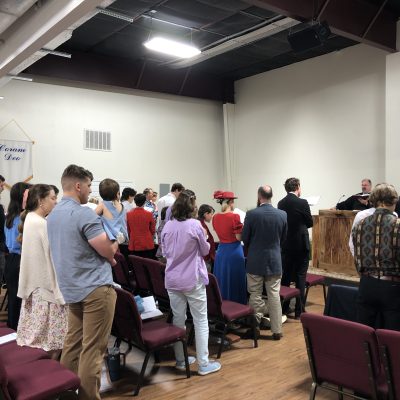
Considering their value in God’s eyes and His commands to parents in Scripture, we know that we aren’t to leave our little ones to themselves, hoping they’ll figure out and learn about God, His world, His church, His worship, how they should speak and act, etc. on their own. No, they need the instruction, nurture, and the godly example of their parents, as well as that of the church. The presence and participation of children in worship, their praise is a joyful noise in His ears!
Thinking about the various challenges that you parents have with shepherding and teaching your children to worship, even while they’re in worship, what are some practical training tips to help you and your children grow in preparation, presence, and participation together with the body.
A good place to start is you parents knowing and embracing your responsibility to train them. It’s true that some parents know their responsibility, but don’t embrace it. They know what they should do, but don’t have a zeal and commitment to carry it out, and therefore don’t consistently. Yet, both are needed for such training to move forward successfully. Therefore, by God’s grace, have a sincere desire to be faithful in following Proverbs 22:6 and Ephesians 6:4, among other passages. Keep in mind that you’re not just going to church with your children to have them hopefully sit quietly and not be a distraction. Rather, you’re going to worship the living God together, training them to do so well. Contrary to what some Christians may think, your children don’t interfere with God’s purpose on His day. They’re an integral part of God’s purpose and worship on His day. Remember when Jesus’ disciples once thought of children as an interference in Matthew 19:13-15. What did Jesus do? He rebuked them. He told His disciples to let the little children come to Him, laid His hands on them, and blessed them.
- Having this mindset and focus, start training your children at home. Your home in many ways is one of the best training grounds. Don’t miss the daily opportunities your time with them during the week there provides. Train your little ones to pray in Worship by sitting quietly and folding their hands while you pray in family worship, when you ask God’s blessing on a meal, and put them to bed. Train them to listen to a sermon by teaching them to sit still and pay attention during the reading of Scripture and brief time of instruction in family worship. You can also do this at other times, incrementally increasing the sitting and attention time, encouraging them as you go. Train them to sing some of the familiar psalms and hymns by singing during the same, maybe before putting them to bed.
- Prepare for Worship. Since the Lord’s Day is the “Christian Sabbath” (Westminster Confession of Faith 21.7), we must prepare our hearts and our bodies for it. It’s good to be in the practice of all members of the family going to bed at a reasonable time to get enough rest Saturday night. It’s helpful to sing the “Psalm of the Month” as a family, which now you can do for both services. Read the sermon texts on Sunday before you come to the service. Train your children to remember to bring their Bible with them to church. As much as is possible, arrive with plenty of time to spare. Take your seats five minutes or so ahead of the start of Worship (i.e. when you hear the church bell ring) to calm and focus hearts and minds.
- Be prepared for the fidgets and noises of young children in Worship. It’s good for both parents and the congregation as a whole to be mindful of and have ready patience and grace for the noises of children in Worship, joyful and otherwise. This being said, it’s also good for you parents to be mindful of the noises and volume levels of your children and train them in the pew, like you did at home, to sit quietly and pay attention when they aren’t participating in congregational speaking or singing. Making verbal connections with them, saying, “You need to sit still now just like you do when we practice at home.” can also be helpful. With babes and nursing infants, the coos and soft babblings are welcome. If they are getting too loud or fussy, back rubs, back pats, hand rubs, repositioning on your lap, lap bouncing, letting toddlers stand and stretch on your lap, letting young children stand and stretch in your row can be helpful. Fathers and mothers working together to shepherd all of their children during the service is important. Dad attends to the young children, while Mom tends to the baby, etc. If quiet redirection or correction isn’t effective in the pew, and any are beginning to be disruptive, it’s good for you to take them out to the Cry Room promptly, or side room in the back, not to play with toys, but to provide necessary care, discipline, redirection, and return to Worship with them as promptly as possible. Keep in mind that training, and the good fruit of it, by God’s grace, comes with repetition and time. Don’t be discouraged after only a couple of weeks. Look for and celebrate incremental growth and improvement.
- Participate in Worship. Give your children a bulletin and hymnal, and train them to follow along and sing. Train them to open their Bible and read as the Scriptures are read and preached. It can also be helpful to encourage them to take notes during the sermon for their own comprehension, growth, and later discussion. Make it a habit to encourage and/or remind your children to join in reciting the 10 Commandments, praying the congregational Prayer of Confession and Supplication, the Lord’s Prayer, as well as reciting the creed.
Though there’s much more that can be offered, I hope that these tips are of tangible and practical help to you and your children as you prepare and participate in Worship together as a family. If you have questions, or need more specific help and ideas for your kids, please ask.
In many ways, training your child(ren) to worship the triune and living God is the most important thing you can teach them. Know and embrace your responsibility to do so, praying God will grant much growth and sanctification in your children and family for His honor and glory.