
“Let us hold fast the confession of our hope without wavering, for He who promised is faithful. And let us consider one another in order to stir up love and good works, not forsaking the assembling of ourselves together, as is the manner of some, but exhorting one another, and so much the more as you see the Day approaching.” – Hebrews 10:23-25
As the people of the living God are devoted to walking with, growing in relationship with, serving, and worshiping Him in spirit and truth, we are also called to be mindful and diligent in carrying out our duties with faithful regularity. Westminster Confession of Faith 21.6 teaches us that God is to be worshiped everywhere (Mal. 1:11; 1 Tim. 2:8) in spirit and truth (John 4:24) ; as in private families daily (Deut. 6:6-7; 2 Sam. 6:18, 20; Job 1:5; Jer. 10:25; Acts 10:2; 1 Pet. 3:7, Matt. 6:11) , and in secret each one by himself (Matt. 6:6; Eph. 6:18), so more solemnly in the public assemblies, which are not carelessly or willfully to be neglected or forsaken, when God, by his Word or providence, calleth thereunto (Isa. 56:6-7; Prov. 1:20-21, 24; 8:34; Luke 4:16; Acts 2:42; 13:42; Heb. 10:25).
Though being faithful can be a challenge, and you may be repeatedly tempted to stop altogether, how are you doing in regularly worshiping God in secret, or privately? If you have a family, are you seeking to do so daily together? Are you and your family regularly present in the public assembly, in corporate worship? These are all needed practices that we need to be disciplined to be faithful in. We may receive the instruction from the Word well and nod our heads in agreement that God calls us to do them with joy. Yet, our practice in actually doing them may be another story. We often need the correction of the Word and Spirit, sometimes of the elders, when we go astray, or let things get in the way. We need helpful correction when we don’t prioritize our time and schedule well, when we don’t prepare well for the Lord’s Day and get in the habit of skipping rather than gathering together with the assembly of God’s people on His Day, in His presence.
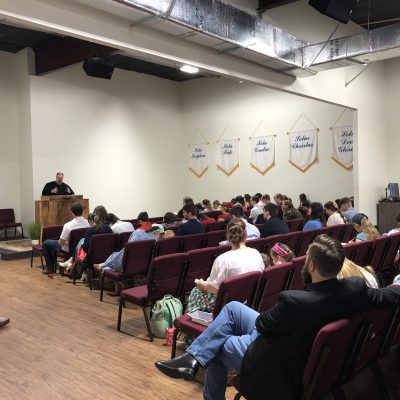
Part of the beauty of Christ’s design of His church and her worship of Him is the collage of people who comprise His bride- young, old, single, married, families with children all coming together in the unity of the Spirit, as the body of Christ, to offer wholehearted worship to the living God together. This beautiful, corporate gathering of families as the family of God is what I want to focus on for a few moments today. Consider a few things:
- It’s in the church, and even as we’re assembled on the Lord’s Day, that we see the organic relationship between the work of Christ, salvation, and the existence of the corporate body. It’s there at we’re to stimulate, motivate, exhort and encourage one another.
- The writer teaches us that we’re to have tender affection and concern for one another. We’re mindful of each other’s weaknesses and temptations, and therefore don’t provoke one another to sin, but to love and good works, calling each other to love Christ more, to love obeying Him and walking in holiness more, and love one another more by our prayers, teaching, fellowship, singing, and example.
- We need to recognize the meaning and importance of not forsaking our assembling together, and by God’s grace, see the good fruit bear in our sustained or improved regularity. The “forsaking” language the writer uses in our focus text suggests that rejecting God Himself is close at hand. (Deut. 28:20, 1 Sam. 8:8) The writer points us to the reality that even then there were some who forsook the assemblies, and so began to apostatize from Christianity. It’s true that forsaking God’s people risks forsaking God Himself.
So, as Christ’s body gathers for worship, how should we do so? Should children be in the service with their families? Should they be separated and have their own activity during the service? How should we handle distractions and noises? The answers to these questions and others will be the focus of this devotion series.
The biblical practice that we see in Scripture is that of families worshiping together. Children of member families, of all ages, are members of the church, whether communicant or non-communicant. They should be in worship with their families. Scripture teaches us that children were present in public worship in Moses’ time (Ex. 10:7–10; 12:26–27; 13:8, 14–15; Deut. 31:12–13), in Nehemiah’s time (Ezra 10:1; Neh. 8:1–3), in Jesus’ time (Matt. 18:1–5; 19:13–15; Mark 10:13–16; Luke 18:15–17), and in Paul’s time (Eph. 6:1–4; Col. 3:20). I encourage you to read this passages and be blessed by their significance.
More about the presence and participation of families, and training of children in Worship in the next edition.