
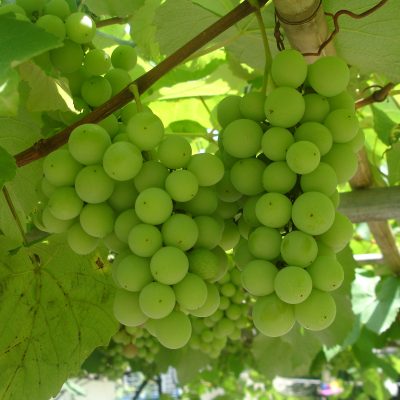
“I am the true vine, and My Father is the vinedresser. Every branch in Me that does not bear fruit He takes away; and every branch that bears fruit He prunes, that it may bear more fruit. You are already clean because of the word which I have spoken to you. Abide in Me, and I in you. As the branch cannot bear fruit of itself, unless it abides in the vine, neither can you, unless you abide in Me. “I am the vine, you are the branches. He who abides in Me, and I in him, bears much fruit; for without Me you can do nothing. If anyone does not abide in Me, he is cast out as a branch and is withered; and they gather them and throw them into the fire, and they are burned. If you abide in Me, and My words abide in you, you will ask what you desire, and it shall be done for you. By this My Father is glorified, that you bear much fruit; so you will be My disciples.” – John 15:1-8
As we’ve been blessed to consider six of Jesus’ I AM statements thus far in the Gospel of John and the marvelous revelation He gives in them about Himself, we’ve grown to see more of His person and attributes regarding His power to nourish, guide, and protect. Our awe and praise has been taken to new heights knowing Christ to be the exclusive way to the Father and salvation, and His being the source and giver of life both now and forever. We now come to Jesus’ seventh and final statement in which He presses to you His being the source and sustaining power of life and good fruit in the members of His church.
In proclaiming Himself to be the true vine, and His Father the vinedresser, you can see a wonderful connection in the whole counsel of God, not only regarding a biblical theology of the vine, but a beautiful picture of Christ and His church. Think back to Asaph’s words in Psalm 80:8-9 “You have brought a vine out of Egypt; You have cast out the nations, and planted it. You prepared room for it, and caused it to take deep root, and it filled the land.” Connect this to Hosea’s prophecy in Hosea 11:1 “When Israel was a child, I loved him, and out of Egypt I called My son.” Hosea’s prophecy speaks of Israel being called out of Egypt in the Exodus, and in Matthew 2:15 you find more prophetic fulfillment in the revelation that the history of God’s redemption of Israel points to Jesus, the true Son of God, being called out of Egypt to return to be with and call His people out of bondage to sin and darkness, as well as minister to them.
Further, notice that Jesus isn’t some weed that sprang up. No, He is a vine intentionally planted in His Father’s vineyard. Scripture teaches you that He wasn’t an attractive vine to behold and gaze upon. As the prophet Isaiah foretold in Isaiah 53:2 “For He shall grow up before Him as a tender plant, and as a root out of dry ground. He has no form or comeliness; And when we see Him, there is no beauty that we should desire Him.” And yet, Jesus gloriously is a vibrant, spreading vine who is salvation to the ends of the earth. (Isaiah 45:22-23)
Indeed, Jesus is the true vine, who is in every way unique and different from all counterfeit and wild vines that deceived those who gathered from them. (2 Kings 4:39) It’s true that counterfeits spread their dastardly influence by making themselves look very similar to the true vine. “Come, tap into my root. Let my sweet sap run through your veins.” they say. Yet, that sap is nothing but poison that doesn’t produce any godly fruit, but only brings death. Where does Jesus say the proof lies? The proof that He is the only, true, divine vine is in the fruit of those who are branches connected to Him and are in Him. (v. 2)
Now, some of you may be wondering, “Pastor, every branch connected to Christ should be alive and bear good fruit, right? How can Jesus say, “Every branch in Me that does not bear fruit He takes away…”? This is a good question. Jesus is speaking of those who pass for branches in Christ, such as false converts and hypocrites, who yet do not bear fruit. If they were really united to Christ by faith, they would bear fruit; but being only tied to Him by the thread of an outward profession, though they seem to be branches, their lack of fruit shows that they are dry and lifeless. Judas Iscariot is a good example of this. (John 12:4-6) As the good Vinedresser tends His vineyard, He removes the dead branches, casting them into the fire and they are burned. (v. 6) In contrast, what is true of branches with lively faith? He sanctifies and prunes you so that your fruit will be even greater in quantity and quality, by His grace and for His glory. Not only this, but Jesus cleanses and keeps His church pure by His very word, even His expelling word by which dead branches are purged from the body. (John 13:27, Matthew 16:6, Matthew 25:31-46) Praise the Lord!
So, having clarity of the lay of the vineyard, the life of the true vine, and hearts of men, hear His evangelistic call to the lost, as well as embrace, and obey Christ’s call to you as living branches to abide in Him. The doctrine of the perseverance and preservation of the saints is before you. Jesus’ call to you is, “Abide in Me, and I in you.” As you accept, receive, and rest upon Christ alone in true saving faith, you are united to and abide in Him. This being true, the call is also for you to continue to abide in Him by His sustaining grace. Don’t go after counterfeits, thinking that you can bear good fruit through them. The greener grass, the easier life is never real in them. There is no holy or fruitful life except one lived by faith in Christ. Therefore, continue to walk in and with your first love. Abide, or lit. dwell in Him. Cling to Him. Keep His way. Love Him with your whole heart knowing who He is, His work for and in you, and grow in both love and service to Him. Engage in fervent, daily prayer, having Christ’s words dwelling in you, being aware that answered prayers come from knowing, loving, and praying according to His revealed will in Scripture. In all of this, be blessed in doing so, Beloved, knowing the truth of verse 8 – that bearing much fruit is the path of honoring and glorifying God, as well as having strong assurance of your salvation. (2 Peter 1:5-11)