
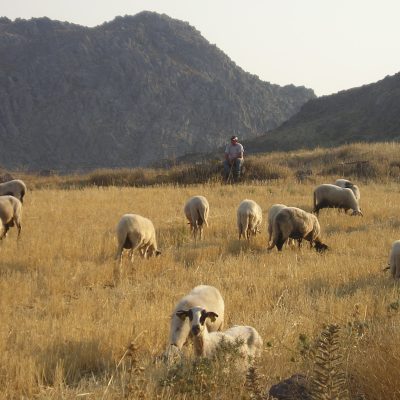
“I am the good shepherd. The good shepherd gives His life for the sheep. But a hireling, he who is not the shepherd, one who does not own the sheep, sees the wolf coming and leaves the sheep and flees; and the wolf catches the sheep and scatters them. The hireling flees because he is a hireling and does not care about the sheep. I am the good shepherd; and I know My sheep, and am known by My own. As the Father knows Me, even so I know the Father; and I lay down My life for the sheep. And other sheep I have which are not of this fold; them also I must bring, and they will hear My voice; and there will be one flock and one shepherd.” – John 10:11-16
Who do you say Jesus is? Do you proclaim with Peter in Matthew 16:15 that He is the Christ, the Son of the living God? Indeed, this is true and you should proclaim it with courage and joy from the housetops. As we’ve been making our way through Jesus’ I AM statements, He has wonderfully revealed that He is the bread of life and the light of the world. Christ is the door. Praise Him! Let’s now take a few moments and be blessed to know and gain a deeper understanding of Jesus being the good shepherd.
As you consider His declaration, notice the characteristics Christ focuses on in describing what His being the good shepherd means. He does so by way of contrast. It’s true that as you consider sheep husbandry and shepherds, there are good shepherds who are faithful and careful in carrying out their duties with their sheep. There are also bad shepherds who fail to care for their sheep and neglect them. There are those who would prey on their own sheep, or allow wolves and others to do so. God speaks of such in Scripture. Here are a few passages to consider:
- Through the prophet Ezekiel, God pronounced a woe on the shepherds of Israel who fed themselves, instead of the flock. They ruled the sheep with cruelty and left them to wander. (Ezekiel 34:1-31) “So they were scattered because there was no shepherd; and they became food for all the beasts of the field when they were scattered. My sheep wandered through all the mountains, and on every high hill; yes, My flock was scattered over the whole face of the earth, and no one was seeking or searching for them.” (Ezekiel 34:5-6)
- The word of the Lord came against Babylon through the prophet Jeremiah in Jeremiah 50:6 “My people have been lost sheep. Their shepherds have led them astray; They have turned them away on the mountains. They have gone from mountain to hill; They have forgotten their resting place.”
- God also pronounced a Woe against worthless shepherds in Zechariah 11:17 “Woe to the worthless shepherd, who leaves the flock! A sword shall be against his arm and against his right eye; His arm shall completely wither, and his right eye shall be totally blinded.”
So, in contrast to worthless and wicked shepherds, Christ shines brightly and meaningfully as the good shepherd. Again, where does He put the focus regarding His goodness in John 10? See in verse 11 that Jesus is the good shepherd because of who He loves and what He gives. He is also the good shepherd because He knows (v. 14), and these are marvelously connected. As you ponder this more, know that the shepherd imagery was commonly used to regard a king. This is true of God (Psalm 23:1) and David (Psalm 78:70-72). Christ, the Son of God and Son of David now reveals Himself to be the shepherd King who out of deep covenant love, gives His life for the sheep.
Yes, good shepherds guide, guard, and feed their sheep. Jesus not only does that, along with standing to fend off and fight against the wolves, contrary to the hirelings, but He lays down His life for His lambs. He came to carry out substitutionary atonement for His people. He came to take our place and be the propitiation for our sins (1 John 2:2). What does propitiation mean? It means that Christ, in His perfect life and atoning, substitutionary death, satisfied the wrath of God against our sin and against us. It is also true that through His substitutionary atonement, Jesus expiated your sins, that is He removed the sin and the guilt that comes with your sin. (Hebrews 10:1-10)
Notice that Christ didn’t say He laid down His life for all men. He didn’t give His life for the goats. No, Jesus died for those He knows, those He owns, because God the Father gave them to Him in election (John 10:29). Among many passages in the Bible, the Apostle Paul teaches you the doctrine of limited atonement in Titus 3:11-14 “For the grace of God that brings salvation has appeared to all men, teaching us that, denying ungodliness and worldly lusts, we should live soberly, righteously, and godly in the present age, looking for the blessed hope and glorious appearing of our great God and Savior Jesus Christ, who gave Himself for us, that He might redeem us from every lawless deed and purify for Himself His own special people, zealous for good works.” [emphasis added]
Beloved, may the loyal covenant love of Christ, your Savior, and the outworking of it in His wonderful works for you, deepen your relationship with Him and adoration of Him as you meditate on His sacrifice for you, as well as Him knowing you and you knowing Him. It’s a beautiful, close relationship, isn’t it? As the gift of God to Christ that you are, He has known you and chose you from before the foundation of the world. (Ephesians 1:3-6) By His grace and Spirit, Christ has changed your heart and opened your eyes in time to see Him in the Scriptures, to believe in and know Him, and love Him. (1 Peter 1:8)
Further, Jesus says His good shepherding continues to extend more as He also works in and through the preaching of the Gospel to gather and unite saved sinners, to gather and unite other sheep who are His from all nations into one church, ruled by Christ the King through His Word. Praise your good shepherd today! Praise Him for His Word!